


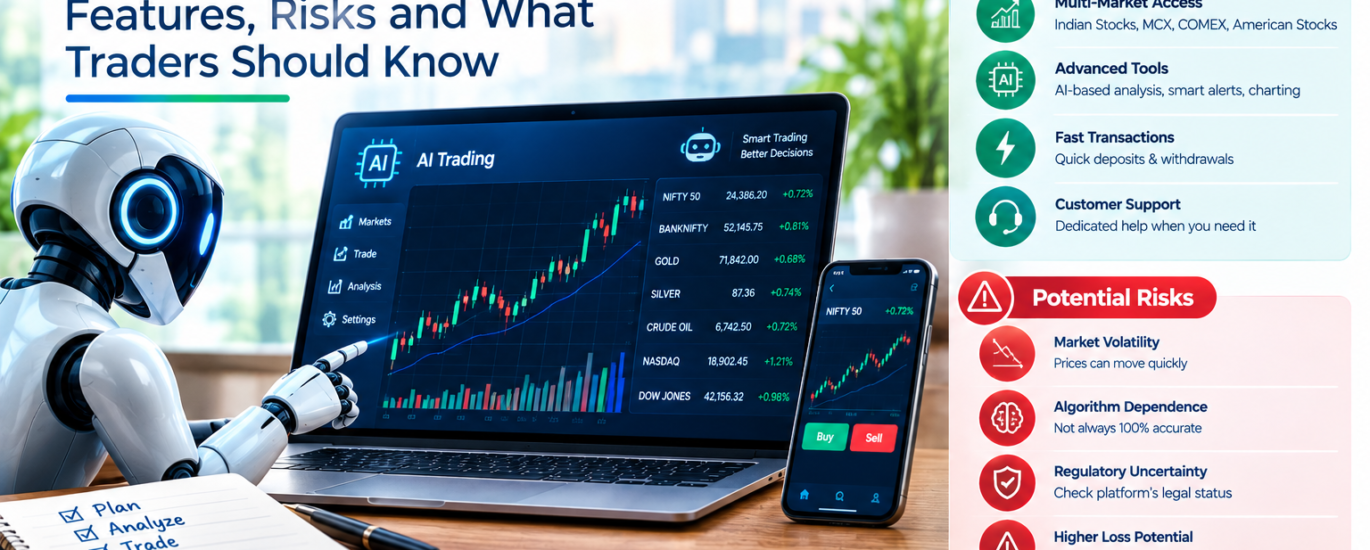
Artificial intelligence is becoming part of the modern trading conversation. From automated alerts to pattern recognition and portfolio analytics, technology can help traders process information faster than manual methods. At the same time, sophisticated tools do not remove market uncertainty. A platform can organize information, but it cannot guarantee that a prediction will be correct. Anyone researching a dabba trading platform should therefore understand the difference between technology, execution infrastructure and regulatory protection.
What an AI-enabled trading platform actually does
AI Trading Platforms features can appear in several parts of a trading workflow. A platform may scan price movements, identify unusual volume, summarize market data, generate watchlists or highlight technical patterns. Some systems also provide natural-language interfaces that allow a trader to ask questions about a market. These functions are mainly designed to reduce repetitive work and make large amounts of information easier to interpret.
The important point is that AI output is an analytical aid, not a promise. Market prices are influenced by news, liquidity, macroeconomic conditions, investor sentiment and unexpected events. Even a model that performed well historically can fail when market conditions change.
Market watch and real-time information
A useful platform should make market information easy to follow. Traders may want live or near-real-time prices, charts, volume data, order information, alerts and relevant corporate or economic news. A well-designed interface can reduce the time spent moving between separate screens.
However, users should ask where the data comes from and whether the displayed information is actually suitable for decision-making. Delayed prices, unclear contract specifications or incomplete disclosures can create a false sense of precision. A reliable service should clearly explain its data sources, market coverage and any limitations.
Margin, leverage and risk controls
Margin is one of the most misunderstood subjects in online trading. Leverage can increase the size of a position relative to the trader’s own capital, but it also increases the effect of adverse price movements. An attractive margin number should never be treated as evidence that a service is safer or better.
Before using any platform, examine how margin is calculated, when additional funds can be requested, what happens during volatile markets and whether positions can be squared off automatically. Risk controls such as stop-loss orders, position limits and clear margin notifications are more useful than simply advertising high exposure.
Understanding the difference between technology and legitimacy
A professional-looking interface does not by itself establish that a trading service is regulated. This distinction is particularly important when a website describes itself as a dabba trading platform. In a conventional regulated environment, orders, settlement, records and intermediaries operate within a defined legal and supervisory framework. In an unregulated arrangement, the user may have substantially fewer protections and may face counterparty, settlement and dispute risks.
Before depositing money, verify the legal identity of the operator, the relevant regulatory registration, the markets offered and the terms governing withdrawals. Do not rely solely on testimonials, screenshots of profits or claims about being the best platform.
AI-generated signals and the human decision
AI can be useful for screening opportunities, but a trader still needs a process for validating a signal. A model might identify a technical formation while missing a pending corporate announcement. It may also react to a temporary price movement that has little lasting significance. Good practice is to treat automated suggestions as one input among several.
Traders should define their risk tolerance before opening a position, decide how much capital can be lost on a trade and understand why an entry or exit is being considered. The objective is not to eliminate uncertainty; it is to manage it systematically.
Security, privacy and account protection
Trading applications handle sensitive information, including identity details, transaction records and financial data. Users should check whether login protection includes strong authentication, whether account activity can be reviewed and how personal information is handled. Suspicious requests for passwords, remote access or payments to unrelated accounts deserve particular caution.
A secure platform should make important account actions visible and should provide understandable terms for deposits, withdrawals and data handling. Traders should also avoid sharing one-time passwords and should use unique credentials.
Questions to ask before choosing a service
A sensible evaluation starts with basic questions: Who operates the service? Is the entity identifiable? Which regulator, if any, supervises it? How are trades executed and settled? What records are provided? What are the fees? How are withdrawals handled? What happens when the market moves sharply? What customer-support and complaint channels exist?
These questions are more valuable than judging a platform by its interface alone. A technology-heavy product can still carry serious operational or legal risks if its underlying structure is unclear.
Final perspective
AI can improve the speed and organization of market analysis, but it does not turn uncertain markets into predictable ones. Traders should separate analytical convenience from regulatory protection, examine leverage carefully and verify the operator before committing funds. When comparing services described as dabba trading in india, it is especially important to understand whether the arrangement falls inside a recognized regulatory framework.
Technology should support disciplined decision-making rather than encourage impulsive trades. The strongest approach combines transparent information, realistic expectations, sensible risk limits and careful verification of the service being used.
Keyword note: Readers comparing services should research dabba trading in india carefully, verify the operator’s identity and understand how orders, records, settlement and withdrawals are handled.
Keyword note: Readers comparing services should research Dabba Trading App carefully, verify the operator’s identity and understand how orders, records, settlement and withdrawals are handled.
Keyword note: Readers comparing services should research dabba trading app carefully, verify the operator’s identity and understand how orders, records, settlement and withdrawals are handled.
A practical evaluation process Start with the operator rather than the promotional offer. Record the legal name, website terms, support details and any stated registration. Then map the transaction journey from deposit to order to settlement to withdrawal. This simple exercise often exposes important gaps that are hidden by a polished user interface. Next, calculate a realistic