
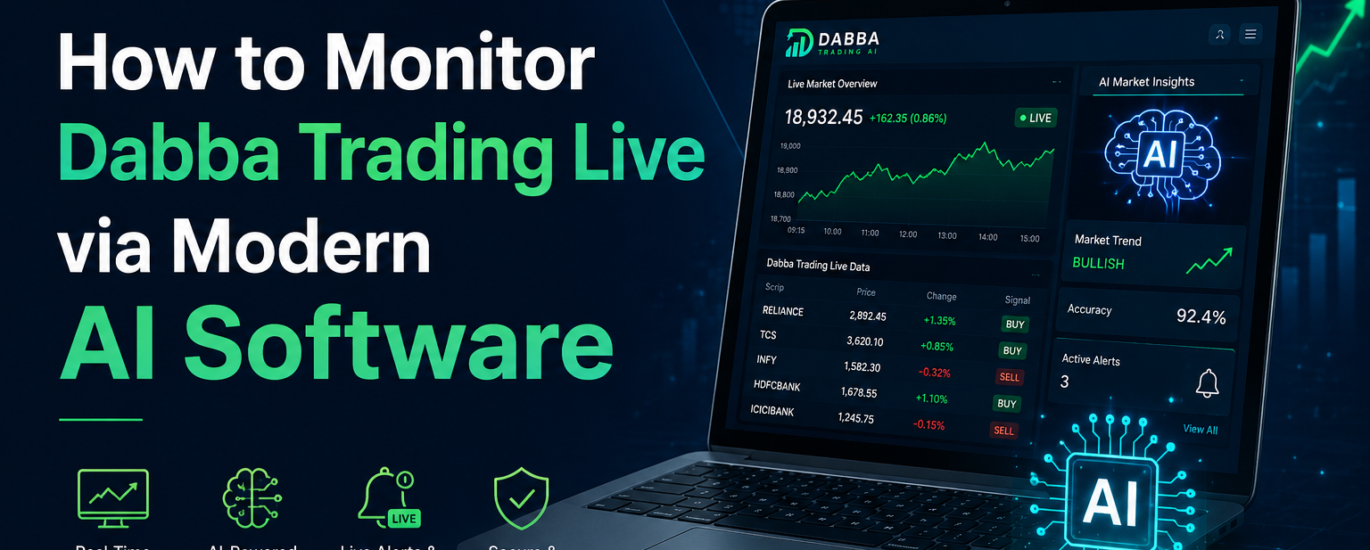
For the alternative traders, the split-second execution is the difference between a highly profitable day and a massive loss. The parallel market operated on rough, handwritten ledgers, where the scenario of the financial world is moving at a breakneck pace. Trades on the chaotic phone calls and the written ledgers are all gone, which inevitably introduces severe execution lag. This can often happen if you try tracking erratic price movements through outdated channels. The revolutionary wave has hit the technological side of trade, where it has transformed how informal market enthusiasts operate. Integrating Artificial Intelligence is what modern software platforms are being rewritten. Monitoring dabba trading live is no longer about chasing a voice on the phone, but is about leveraging automated, ultra-low-latency algorithms. This syncs with the mainstream market data in real time. This technical evolution ensures that self-directed investors can now capture instant price fluctuations with absolute digital precision.
The Technical Evolution of Parallel Market Tracking
The traditional trading market or the platforms have suffered from a massive technological deficit. In the earlier days, the traders historically relied on manual operators who typed out numbers via voice notes. This practice creates a bottleneck during high-volatility sessions. All these have been rectified with modern software. It completely removes human error by replacing old communication channels with direct data streaming APIs. The advanced digital system pulls price actions directly from mainstream data feeds, parsing millions of ticks per millisecond. The numbers displayed on your dashboard are the actual ones underlying market conditions instantly.
Eradicating Execution Latency Through Cloud Infrastructure
Latency is the ultimate portfolio killer in trading. The order execution platforms are migrated onto distributed cloud networks, where the alternative trading applications have successfully brought data processing to the user. AI algorithms constantly optimize data route pathways, and they find the fastest server nodes to transmit trade requests. Here, your transactions will never have a block, and there will be instantaneous order execution even during peak market hours.
Automated Margin Calculations and Leverage Management
The major trading attraction of the alternative platforms is the access to massive capital leverage. This often reaches well beyond standard regulatory limits. However, trading with immense leverage requires efficient risk management tools, where modern trading platforms offer AI-driven trading dashboards. It features sophisticated automated risk engines that continuously calculate our maintenance margin in real time. The platform with an AI-driven tool will instantly update the risk parameters if a fast market signal threatens your open positions. This helps you get a clear vision of your liquid capital boundaries without requiring complex mental math.
Real-time Multi-asset Tracking on Unified Dashboards
A professional or dedicated intraday scalper rarely limits themselves to a single asset class. They often keep a close eye on equity derivatives, global indices, and commodity segments simultaneously. An advanced platform will offer traders highly customizable, multi-window dashboards that stream diverse asset classes. This can be seen alongside each other on a single screen. This allows you to spot micro-correlations with the centralized data architecture. The crude oil or gold price influences a particular equity index, which can be understood, and this allows you to act on market opportunities across different sectors without toggling between disjointed apps.
Paperless Onboarding and Seamless Digital Interface
The exhausting paperwork and the lengthy verification delays often make the intrusive compliance cycles that slow down our market entry. If you plan to move your strategy into the No. 1 Trading Site in India, they provide you with a fully digital onboarding process. The platforms are more focused on the users and are designed from the ground up to minimize administrative frictions. This allows users to establish their profile and configure their trading dashboard.
Machine Learning Algorithms for Pattern Recognition
Sophisticated trading platforms incorporate predictive machine learning models. This helps the users make sense of historical data. The built-in AI constantly scans historical volume bars and structural price charts. This helps in highlighting the developing patterns, such as support breakouts or sudden momentum shifts. Even though the automated features highlight, it doesn’t mean they place the trades for you. They often serve as a powerful analytical tool that filters out irrelevant market noise. Also, it draws your attention to high-priority cart setups.
Superior Platform Reliability for High-volume Players
Cheap and poorly coded retail applications often freeze up when the market volatility spikes. And sometimes, they suffer from severe server crashes and thus leave users completely locked out of their positions. A platform with high-performance software architectures is specifically built to withstand such crashes and intense concurrent user traffic. The platform dynamically redistributes data traffic by deploying load-balancing technologies. This is done across multiple servers during high-volume events. This ensures that your charting tools, balance readouts, and transaction logs remain fully functional and responsive.
Bottom Line
There is a loaded checklist to keep a strict margin buffer, configuring real-time alerts, etc., for the convenience of trading faster in the AI-driven technological platforms. Try choosing the best dabba trading sites that ensure you eliminate traditional execution delays and minimize transaction overheads.