


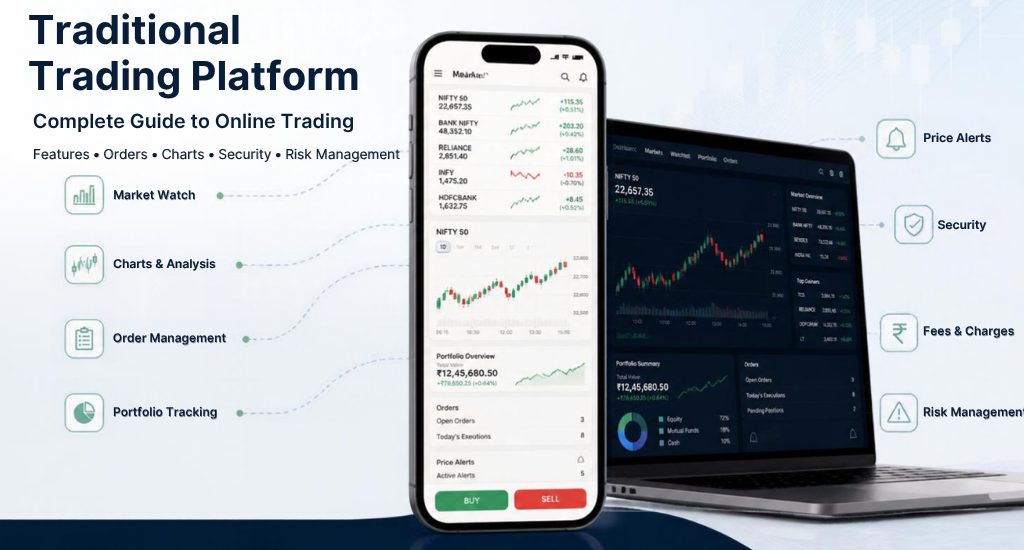
Trading platforms and have changed significantly as technology has become part of everyday market analysis. Traditional platforms generally provide tools such as charts, price feeds, order entry, watchlists and technical indicators. AI-enabled platforms add another layer by using algorithms to process large amounts of market information and identify patterns or signals.
What Is a Traditional Trading Platform?
A Traditional Trading Platform is software that allows users to access market information and place trades through a regulated broker or exchange-connected intermediary. Depending on the market, users may see live or delayed prices, charts, order books, technical indicators, portfolio information and transaction records.
The main feature is user control. Traders normally study the available information, decide on an entry or exit, choose an order type and manage the position themselves. This approach can be useful for people who prefer to understand each decision rather than rely heavily on automated analysis.
What Is an AI Trading Platform?
An AI trading platform uses machine-learning or other algorithmic techniques to process data. Depending on the system, this may include price history, volume, volatility, technical indicators, news or other structured information.
The term “AI” does not automatically mean that a platform can predict markets accurately. Financial markets are affected by unexpected events, liquidity changes, economic announcements and investor behaviour. AI can help organise information, but it cannot remove market risk.
Key Differences
The biggest difference is the way information is processed. Traditional platforms usually present tools and data for the trader to interpret. AI-enabled platforms may analyse larger datasets and highlight patterns, unusual price movements or potential areas for further research.
Automation is another difference. Some AI systems can generate alerts, summaries or rule-based suggestions. A traditional platform may require the trader to create and monitor those conditions manually.
However, advanced automation should not be confused with guaranteed performance. Any trading strategy needs testing, risk controls and continuous monitoring.
Data and Analysis
AI systems can process many variables quickly. For example, a trader researching an index may want to compare historical volatility, volume changes and technical indicators. An AI-based workflow can help organise these inputs and produce a structured summary.
Traditional platforms remain useful because traders can directly inspect charts, indicators and order information. In practice, the two approaches can complement one another.
User Experience
Traditional interfaces are often designed around direct market access and manual decision-making. AI features can add natural-language summaries, alerts, pattern recognition and data filtering.
For beginners, simplicity is important. A platform with many automated features may look impressive but still require the user to understand orders, leverage, fees and risk. Learning the fundamentals remains essential.
Risk Management Matters
Whether someone uses an AI trading platform or a traditional trading platform, risk management is central. Traders should understand position size, stop-loss orders where appropriate, transaction costs and the possibility of losing money.
For users in India, it is also important to distinguish regulated exchange-based trading from unregulated arrangements. SEBI states that dabba trading is illegal and unregulated and that such trades are outside the official exchange and regulatory framework. citeturn0search0turn0search5
Which Type Should Traders Understand?
The answer depends on the trader’s needs and experience. A traditional platform may provide a straightforward environment for learning market mechanics. AI features may be useful when a trader needs help screening or organising large quantities of information.
Rather than treating AI as a replacement for financial knowledge, traders can view it as an analytical tool. Checking the source of market data, understanding how an algorithm works and reviewing assumptions are all important.
Final Thoughts
AI and traditional trading platforms serve overlapping but different purposes. Traditional platforms focus on direct access to market data and trading tools, while AI-enabled systems can add automated analysis and information processing. The most important consideration is not the label “AI” but the platform’s transparency, reliability, security, costs and regulatory status.
Anyone trading in India should verify that the intermediary is appropriately regulated for the services offered and should understand the risks before placing trades.
