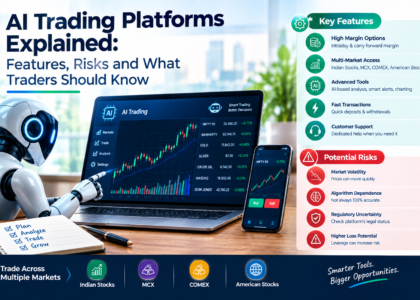


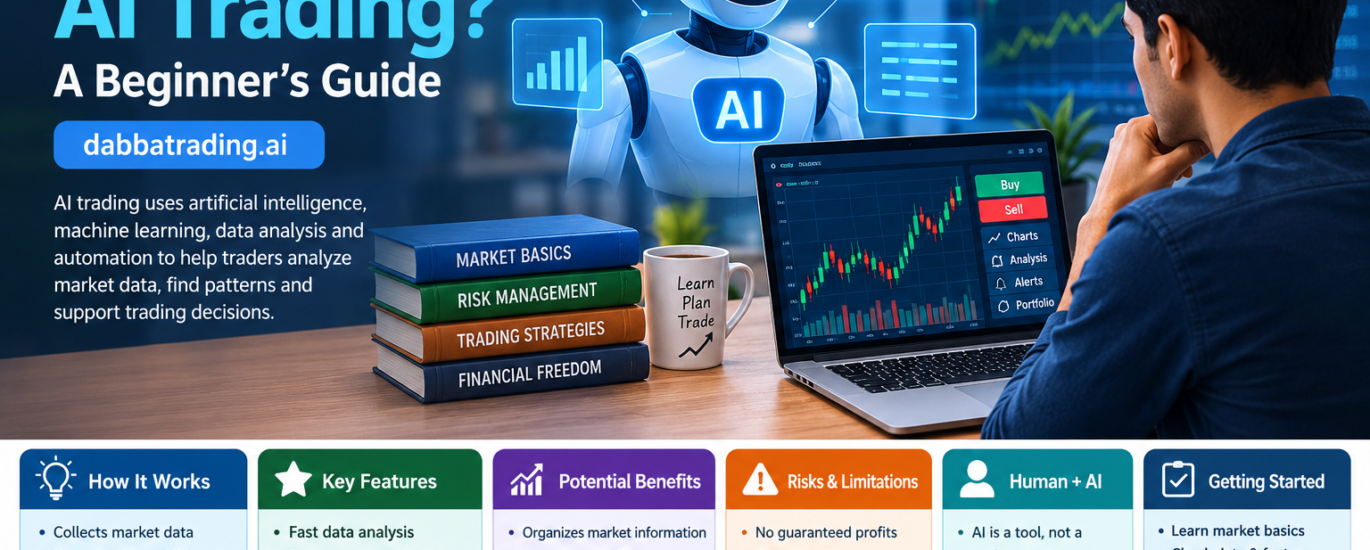
Artificial intelligence has become one of the most discussed technologies in modern financial markets. From analyzing large amounts of market data to identifying patterns and helping traders organize information, AI can change the way people approach trading. But for someone who is new to the subject, the term AI trading can sound complicated. In simple terms, AI trading refers to the use of artificial intelligence, machine learning, data analysis, and automation to support parts of the trading process.
This does not mean that an AI system can predict every price movement or guarantee a profit. Financial markets are influenced by many factors, including economic data, company results, interest rates, global events, liquidity, and investor sentiment. AI can process information quickly, but it still works with uncertain data and models. A beginner should therefore understand both the potential uses and the limitations before relying on any technology.
What Is AI Trading?
AI trading describes trading systems or software that use computational techniques to analyze financial information and assist with trading decisions. Traditional software generally follows fixed instructions, while AI-based systems may use statistical models or machine-learning methods to identify relationships in historical and real-time data.
An AI-enabled system may examine price movements, trading volume, technical indicators, news-related information, or other structured data. Depending on its design, it can generate alerts, rank opportunities, identify unusual activity, or automate a predefined order process. The exact features vary considerably from one platform to another.
How Does AI Trading Work?
A typical AI trading workflow starts with data. The system may receive historical prices, volume, market indicators, company information, or other datasets. The data is cleaned and processed before an algorithm looks for patterns or relationships.
Machine-learning models can then be trained using historical examples. During testing, developers check how a model behaves on data it has not previously seen. If the system is connected to a trading platform, its output may appear as a signal or be used within an automated strategy.
The important point is that an algorithm does not remove uncertainty. A model trained on historical conditions can behave differently when market conditions change. For that reason, testing, monitoring, and risk controls remain important.
Common Features of AI Trading Systems
One common feature is automated data analysis. AI can examine a large volume of information much faster than a person working manually. This can be useful when a trader follows several markets at once.
Another feature is pattern recognition. Algorithms can search for recurring combinations in price, volume, or other variables. Some systems also produce alerts when specified conditions occur.
Portfolio and risk analysis can be another use. A system may calculate exposure, track positions, monitor concentration, or flag movements that require attention. These tools can help organize information, although they do not eliminate financial risk.
Some applications also include natural-language interfaces. A trader may be able to ask a question in ordinary language and receive a summary of selected market information. The usefulness of such a feature depends on the quality and freshness of the underlying data.
Potential Benefits for Beginners
AI can make market information easier to organize. Instead of manually reviewing many charts or datasets, a trader can use software to filter information according to selected conditions.
Automation may also reduce repetitive work. For example, an application can monitor a set of instruments and generate an alert when a chosen rule is triggered. This can help traders maintain a more consistent process.
AI can also support learning when used as an educational assistant. A beginner can study concepts such as moving averages, volatility, order types, or historical price behavior with analytical tools. However, learning tools should not be confused with guaranteed trading signals.
Risks and Limitations
The biggest misconception about AI trading is that artificial intelligence automatically means accurate predictions. It does not. Models can produce false signals, overfit historical data, or fail when market conditions change.
Data quality is another concern. Inaccurate, delayed, incomplete, or poorly structured information can affect an algorithm’s output. Costs also matter. Brokerage charges, spreads, taxes, slippage, and other expenses can reduce the results of an otherwise promising strategy.
Automation creates operational risks as well. Connectivity problems, software errors, incorrect settings, or misunderstood order instructions can produce unexpected outcomes. A trader should understand exactly what a system is allowed to do before enabling automated execution.
AI Trading and Human Decision-Making
AI is best understood as a tool rather than a replacement for judgment. A trader can use technology to collect and analyze information while still deciding how much capital to risk, what objectives to follow, and when to stop using a strategy.
A sensible process includes defining risk limits, testing ideas, reviewing performance, and avoiding decisions based only on a single algorithmic signal. Beginners should also distinguish between regulated trading services and informal arrangements that may not provide the protections associated with regulated markets.
Getting Started Carefully
Someone exploring AI trading can begin by learning basic market concepts first. Understanding market orders, limit orders, leverage, volatility, position sizing, and stop-loss mechanisms provides useful context for evaluating technology.
Next, examine how an AI tool obtains its data, what market it covers, whether its results can be independently tested, and what costs apply. Look for clear information about the provider, security practices, order execution, and applicable regulation.
It is also useful to test strategies in a simulated environment where available. A paper-trading phase can reveal practical issues before real money is involved.
Conclusion
AI trading combines financial-market data with artificial intelligence and automation techniques. It can help traders analyze information, monitor markets, organize research, and automate selected tasks. At the same time, it cannot guarantee returns and can fail when assumptions, data, or market conditions change.
For beginners, the most useful approach is to treat AI as analytical technology rather than a shortcut to guaranteed profits. A strong understanding of markets, realistic expectations, careful testing, and disciplined risk management remain essential.
For beginners researching AI trading, the most useful approach is to compare what an AI trading platform actually provides rather than focusing only on promotional claims. Check the data source, analytical features, testing process, costs, security, and the level of automation before using any tool.